Kloonhiis
Kloonhiis is a site-specific permanent installation at the open-air wilderness art park of Wild Bits in Maajaam residency, Neeruti, Southern Estonia. The Estonian title of the work combines the word kloon (clone) and hiis (sacred grove). Kloonhiis is a result of research on sacred groves, extensive forestry in the area of Neeruti as well as an appropriation of micro-propagation that’s commonly used in extensive forestry.
Forests have been an essential tool of national identity-building for Estonians in the early 20th century and in the final decades of the Soviet Union, so much so that Estonians nowadays describe themselves as a forest nation. However, the change in harvested forest area in Estonia has increased by a staggering 85% comparing the timeframes 2004-2015 and 2016-2018. It is then within less than 10 years that this rapid change occurred on Estonian land (Ceccherini et al., “Abrupt Increase in Harvested Forest Area over Europe after 2015.”).
This is largely due to the EU’s renewable energy subsidies, which European countries aim to meet. Therefore Estonia, as one of the forest-rich nations has become the second largest exporter of wood pellets for energy production in the EU. Estonia primarily exports to Denmark, the UK, the Netherlands, Belgium, and Italy where pellets regularly get burned in massive power plants, often co-fired with coal (Eräjää, “Wood Pellet Damage.”).
The tendency to demystify nature and see it only as a practical resource conflicts with the Estonian people’s belief that the forest can tell stories and provide a spiritual experience. What is more, it directly jeopardizes the forest’s carbon sink potential, biodiversity, and overall sustainability.
It is now thought that certain plants can even emit sounds that are inaudible to the human ear but are audible to some other living things. So it is only in that they lack language— a human attribute— that trees are mute. But in that humans lack the ability to communicate as trees do, could it not be said that for a tree it is the human who is mute? (Ghosh, The Nutmeg’s Curse)
Scientists now accept that trees in a forest are able to communicate with each other in certain circumstances— they can send help, in the form of carbon, to ailing members of their group; and they can warn each other about pestilence and disease (Kimmerer, Braiding Sweetgrass).
Cloning or propagating plants has a long tradition in our society and agriculture with techniques like stem cutting, layering, and grafting. Nowadays, these techniques, especially micro-propagations, are widely used to ensure maximum harvesting and reproduction of plants or in scientific research. But an artistic practice is rarely explored.
While sacred groves have emerged by communal agreement since pre-Christianity, Kloonhiis begs the question: what is the contemporary communal (societal) agreement on the relationship of people and extractive land use? By cloning a tree from a forest owned by a forestation company due for felling in 2023, Kloonhiis proposes a sacred grove for the Maajaam community, inviting artists and visitors to think of alternative collaborations with nature.
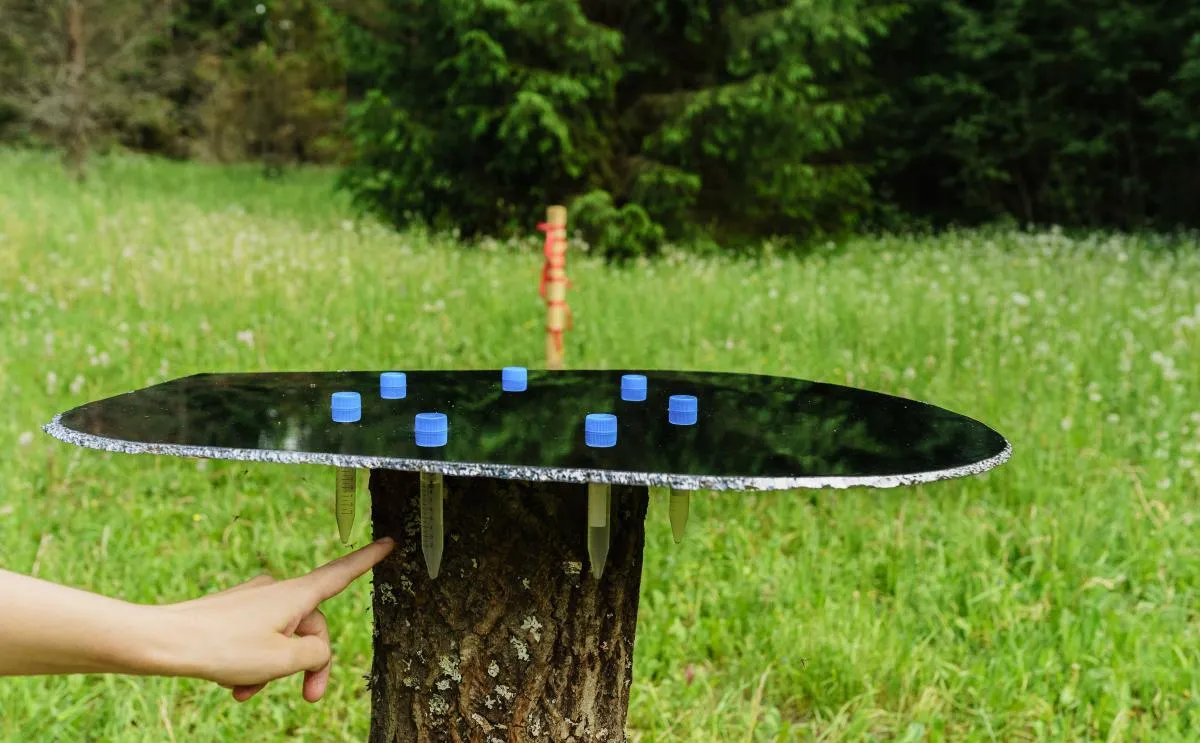
It featured clones of tissue from pine trees (Pinus sylvestris) collected nearby before their scheduled felling. Unfortunately, the plantlets refused to sustain life and so the work itself became an artistic sacrifice on its own.
Natural sacred sites in Estonia have served as a place for spiritual recharge for generations. These sites emerge from a communal urgency and ritual.
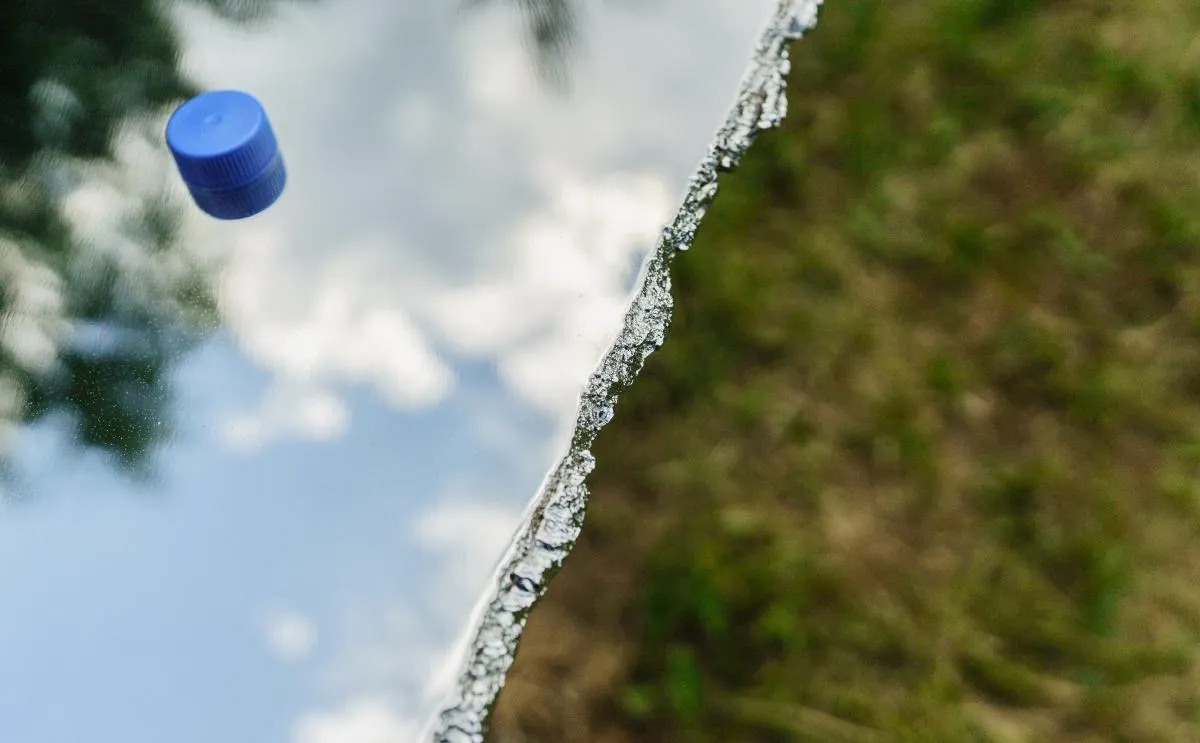
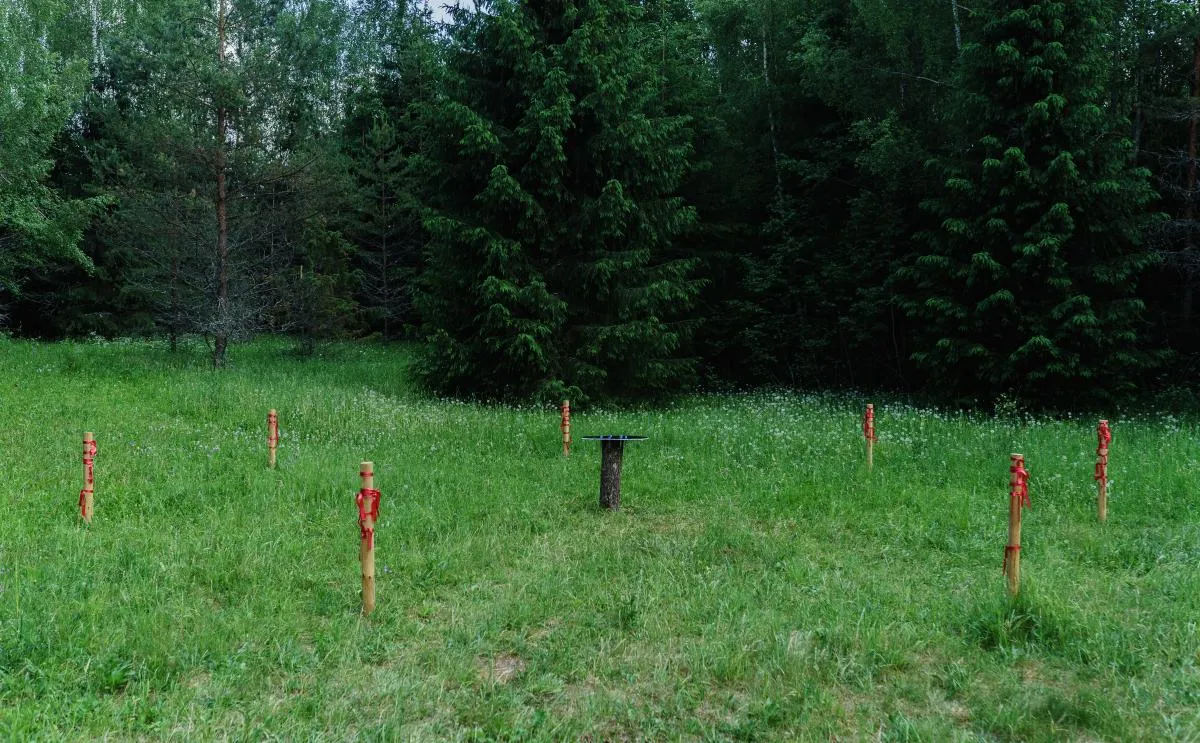
“Kloonhiis” is a circular formation resembling a sacred site. The mirror-like plate embodies artificiality contrasting the complexity of nature that defined the project’s final outcome. Test tubes on the surface house dead clones. The seven wooden poles in the ground are placeholders for the plantlets onto which the audience is invited to tie a traditional ribbon to activate the site.
Supported by: European Capital of Culture Tartu 2024, Cultural Endowment of Estonia
 Epp Kubu, Gabriela Urm, 2024
 Epp Kubu, Gabriela Urm, 2024
 Epp Kubu, Gabriela Urm, 2024